The first few days brought a bitter taste and slight stinging. Pressing beside my nose after each drop helped, and the irritation became less noticeable.
Leeds Several weeks 2 Oct 2026
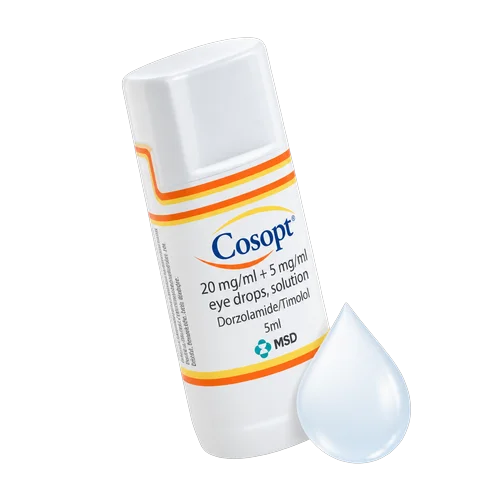
Cosopt
Cosopt is prescribed for adults with ocular hypertension or open-angle glaucoma. Its combined action reduces aqueous humour production and helps limit pressure-related optic nerve damage.
Product information
Dorzolamide hydrochloride and timolol maleate, the active ingredients of Cosopt, lower raised pressure inside the eye. Cosopt is prescribed for adults with ocular hypertension or open-angle glaucoma when one pressure-lowering treatment is insufficient. Its combined action reduces aqueous humour production and helps limit pressure-related optic nerve damage.
What it is used for
Dorzolamide hydrochloride and timolol maleate, the active ingredients of Cosopt, lower raised pressure inside the eye. Cosopt is prescribed for adults with ocular hypertension or open-angle glaucoma when one pressure-lowering treatment is insufficient. Its combined action reduces aqueous humour production and helps limit pressure-related optic nerve damage.
Ingredients
Cosopt is an ophthalmic solution supplied in a bottle containing 5 ml of eye drops. The regimen for the chosen strength must be confirmed with a healthcare professional before starting. The two active substances reduce intraocular pressure through separate but complementary mechanisms.
Active pharmacological ingredients
Cosopt contains:
- Dorzolamide hydrochloride, a carbonic anhydrase inhibitor.
- Timolol maleate, a beta-adrenergic receptor blocker.
- Dorzolamide and timolol in a fixed ophthalmic combination.
- Eye drops in solution form, supplied in a 5 ml bottle.
NICE glaucoma guidance places pressure reduction at the centre of preventing further optic nerve damage, with treatment selected according to the type of glaucoma, pressure level, visual field, and tolerance [1].
How it affects the body
Dorzolamide is a topical carbonic anhydrase inhibitor. Carbonic anhydrase helps support the chemical processes involved in aqueous humour formation. By inhibiting this enzyme, dorzolamide reduces the production of fluid in the eye.
Timolol is a topical beta-blocker. It reduces stimulation of beta receptors in the ciliary body, which also lowers aqueous humour secretion. Less fluid production means lower intraocular pressure.
The effect is localised to the eye, but some of the solution can pass through the tear duct into the nasal lining and then enter the bloodstream. This explains why a topical beta-blocker may still affect breathing, pulse, or blood pressure in susceptible people.
How to use it
The regimen for the chosen strength must be confirmed with a healthcare professional before starting. Cosopt is administered as drops into the affected eye or eyes, according to the ophthalmologist’s prescription.
Practical administration involves these steps:
- Wash and dry your hands.
- Tilt the head back and gently pull down the lower eyelid.
- Place the prescribed drop into the pocket between the eyelid and eye.
- Close the eye gently for around two minutes.
- Press lightly at the inner corner of the closed eye beside the nose.
- Wipe away excess liquid without rubbing the eye.
Punctal occlusion, meaning gentle pressure at the inner corner of the eye, reduces drainage through the tear duct. It can reduce systemic exposure to timolol while retaining the local eye effect. This small technique is easy to miss and matters more in people with asthma, slow pulse, or other cardiovascular risks.
If other eye drops are prescribed, separate them by at least five minutes unless the treating clinician gives different instructions. Ointments generally go last because they can interfere with the distribution of liquid drops.
A missed dose should be used when remembered unless the next scheduled dose is close. In that situation, skip the missed dose and return to the prescribed schedule. Never use extra drops to compensate.
Comparison
Glaucoma treatment can involve one medicine, a fixed combination, laser treatment, or surgery. The correct option depends on pressure response, visual-field risk, eye-surface health, dosing practicality, and other medical conditions.
| Treatment approach | Main mechanism | Typical clinical role |
|---|---|---|
| Cosopt combination drops | Carbonic anhydrase inhibition plus beta-blockade | Dual pressure reduction when one topical agent does not achieve the target |
| Prostaglandin analogue drops | Increase aqueous humour outflow | Common first-line class for many forms of open-angle glaucoma |
| Topical carbonic anhydrase inhibitor alone | Reduces aqueous humour production | Useful when beta-blockers are unsuitable or as an additional option |
Prostaglandin analogues may be preferred when asthma, slow pulse, or cardiac conduction disease makes timolol unsuitable. Their common drawbacks can include conjunctival redness, eyelash growth, and gradual iris or eyelid pigmentation.
Cosopt may reduce the number of separate bottles compared with using dorzolamide and timolol individually. The trade-off is that a patient exposed to either ingredient’s adverse effects may need a different class rather than simply changing the dose.
Common mistakes
Several routine errors can reduce treatment benefit:
- Using two or three drops because the first drop was not felt.
- Touching the nozzle to the eyelashes or eye.
- Blinking repeatedly immediately after application.
- Failing to close the eye or press the inner corner.
- Applying different eye drops one immediately after another.
- Stopping when vision feels stable.
- Replacing a missed dose with a double dose.
- Forgetting to mention Cosopt before surgery or anaesthesia.
- Continuing contact-lens wear during application.
- Treating persistent redness or wheezing as an expected adjustment effect.
One useful detail is that a drop can be difficult to feel, especially when the eye is already watering. Feeling nothing does not prove that the dose was missed. A second drop should not be added automatically.
Another practical point concerns driving. Temporary blurred vision after instillation is more relevant than the medicine’s general effect on alertness. Wait until vision is clear before driving, cycling on the road, or operating equipment.
Who should not use it
This treatment is not for you if you have:
- Bronchial asthma or a history of severe asthma.
- Severe chronic obstructive airway disease with bronchospasm.
- Sinus bradycardia or second- or third-degree atrioventricular block without a pacemaker.
- Overt heart failure or cardiogenic shock.
- Severe renal impairment.
- A previous serious allergic reaction to dorzolamide, timolol, or related sulfonamide medicines.
Important interaction groups include:
- Oral beta-blockers, which can add to the effect on pulse and blood pressure.
- Calcium-channel blockers such as verapamil or diltiazem.
- Digoxin and medicines that slow cardiac conduction.
- Medicines that reduce catecholamine activity, including some drugs used for hypertension.
- Quinidine and selected antidepressants that may increase beta-blocker exposure.
- Other carbonic anhydrase inhibitors, which may increase class-related adverse effects.
When this is not for you
Cosopt may not be suitable if you have asthma, serious breathing problems, a slow heartbeat, heart conduction problems, heart failure, severe kidney problems, or a serious allergy to dorzolamide, timolol, or related medicines. Tell the prescribing clinician about heart rhythm problems, low blood pressure, circulation disorders, diabetes, thyroid disease, myasthenia gravis, corneal disease, or planned eye surgery. Pregnancy and breastfeeding require an individual risk assessment.
Possible side effects
Cosopt can cause local eye reactions and systemic beta-blocker effects. The product information for dorzolamide–timolol combinations lists ocular irritation, burning, stinging, blurred vision, tearing, dry eye, itching, and a foreign body sensation in the eye among possible reactions [2].
The foreign body sensation may feel like grit or an eyelash under the eyelid. Mild irritation shortly after instillation can occur, though persistent pain, marked redness, light sensitivity, or a sudden change in vision requires prompt assessment.
Possible systemic effects include:
- Slow pulse or low blood pressure.
- Fatigue, dizziness, or cold hands and feet.
- Shortness of breath or wheezing.
- Palpitations or changes in heart rhythm.
- Nausea, altered taste, or headache.
- Depression, sleep disturbance, or vivid dreams.
- Rare neurological or psychiatric symptoms, including hallucination.
Respiratory symptoms deserve special attention. Timolol can narrow the airways in susceptible patients, even when used as eye drops. New dyspnoea, wheezing, faintness, severe weakness, or a very slow heartbeat needs urgent medical attention.
Dorzolamide can cause a bitter taste because the drops drain into the throat. Closing the eyes and applying gentle inner-corner pressure after instillation may reduce this sensation. A short period of blurred vision is also possible, so driving should wait until vision has cleared.
What doctors say
In clinical practice, ophthalmologists usually judge Cosopt by the pressure target and the condition of the optic nerve, not by whether the drops produce a noticeable sensation. Glaucoma often progresses without pain or obvious visual symptoms, so a patient may feel unchanged while the treatment is still preventing pressure-related damage.
A practical prescribing review covers pulse, blood pressure, respiratory history, current eye drops, oral beta-blockers, and previous reactions. The clinician also checks whether the patient can reliably place one drop without touching the bottle tip to the eye.
A common problem is technique rather than pharmacology. A large drop does not produce proportionally greater benefit, while repeated instillation can increase drainage into the nose and systemic exposure. Demonstrating the technique at an appointment can reveal why pressure remains above target despite reported adherence.
MHRA safety information for topical beta-blockers supports attention to respiratory and cardiovascular history, since ocular administration does not eliminate systemic absorption [3].
Common questions
Which diet, exercise, or habits help Cosopt work well?
A balanced diet and regular physical activity support cardiovascular health, but they do not replace pressure-lowering eye treatment. The NHS glaucoma pathway emphasises adherence, scheduled pressure checks, and visual-field monitoring as central parts of care, with guidance current through 2022 [4]. Avoid rubbing the eyes, keep the bottle tip clean, and use punctal occlusion after each drop to limit unnecessary systemic absorption.
Can Cosopt affect driving, concentration, or machinery work?
Cosopt may cause temporary blurred vision, dizziness, fatigue, or visual discomfort after application. The MHRA advises caution with topical beta-blockers when systemic effects could impair function; this safety principle remains relevant in 2026. Do not drive or operate machinery until vision is clear and you know how the drops affect you.
Is Cosopt suitable for people under 18?
Paediatric use requires specialist assessment because safety and dosing considerations differ from those in adults. The European Medicines Agency describes dorzolamide–timolol ophthalmic therapy within a regulated product-information framework, with age-specific use determined by the licensed indication [5]. A child or teenager should receive this treatment only through an ophthalmology-led plan.
Can Cosopt cause palpitations?
Palpitations are possible, although timolol more commonly raises concern about a slow pulse or conduction effects. The British National Formulary and MHRA safety principles support prompt assessment of new palpitations, fainting, chest discomfort, or marked dizziness during topical beta-blocker treatment. Do not apply another dose until urgent advice has been obtained if palpitations occur with breathlessness or faintness.
How does Cosopt differ from a prostaglandin analogue?
Cosopt reduces aqueous humour production through dorzolamide’s carbonic anhydrase inhibition and timolol’s beta-blockade. Prostaglandin analogues mainly increase fluid outflow from the eye and do not contain a beta-blocker. NICE guidance from 2022 supports choosing treatment according to pressure control, contraindications, ocular tolerability, and the patient’s risk of visual-field loss.
Is Cosopt appropriate for older adults?
Older adults can use Cosopt when the prescriber has considered pulse, blood pressure, breathing, kidney function, falls risk, and other medicines. WHO guidance on older people and medication safety supports reviewing cumulative effects from medicines that lower blood pressure or slow the heart. Difficulty squeezing the bottle or aiming the drop is common, so an assistant device or technique review may improve reliable use.
Can Cosopt be combined with oral beta-blockers or supplements?
Combining Cosopt with an oral beta-blocker can intensify effects on heart rate, blood pressure, and breathing. The MHRA recognises systemic absorption from ophthalmic beta-blockers, so the full medicine list should include tablets, inhalers, eye drops, and supplements. Products containing stimulant ingredients may also complicate assessment of palpitations or blood pressure changes; report every supplement before the regimen is confirmed.
Do you offer anonymous delivery?
Your order will be securely packed and shipped within 24 hours. This is exactly what your package will look like (images of an actual item sent). It has the size and look of a regular private letter (24x11x0.7 cm) and its contents cannot be seen.
Reviews: Cosopt
Based on 3 reviews
The bottle was straightforward, although I sometimes blurred my vision for a few minutes after using it. I had to build the drops into my morning and evening routine.
Newcastle upon Tyne 14 Oct 2026I noticed wheezing after starting the drops and did not use another dose until I had spoken to the eye clinic. The treatment was changed after my asthma history was reviewed.
Derby 28 Oct 2026Sources
- NICE (2022). Glaucoma: diagnosis and management (NG81)
- electronic Medicines Compendium (2025). Cosopt 20 mg/ml + 5 mg/ml eye drops, solution: Summary of Product Characteristics
- MHRA (2020). Beta-blockers: risk of cardiac and respiratory adverse reactions
- NHS (2022). Glaucoma: treatment and monitoring information
- European Medicines Agency (2019). Guideline on the clinical investigation of medicinal products for the treatment of glaucoma