Skip to content
Fast & Discreet Delivery Save up to 80%
In Stock Estriol
Menopause

Estriol

Estriol cream provides local oestrogen activity in vaginal and vulval tissues, helping relieve dryness, irritation and discomfort linked with oestrogen deficiency after menopause. Estriol is intended…

Guaranteed quality Original product
Delivery: from 4 days Discreet delivery
24/7 Support Always available
Active ingredient: Estriol
Select pack Package Per tablet Price
£ 27.95 £ 55.90
£ 26.09 £ 83.85 £ 78.26 Save 7%
£ 25.16 £ 111.80 £ 100.62 Save 10%
Best value £ 23.56 £ 139.75 £ 117.82 Save 16%

Free delivery on orders from £ 172.00, free express delivery from £ 258.00

Secure payment methods:
VISA AMEX JCB DISCOVER

Estriol cream provides local oestrogen activity in vaginal and vulval tissues, helping relieve dryness, irritation and discomfort linked with oestrogen deficiency after menopause. Estriol is intended for postmenopausal women with genitourinary symptoms, with less systemic exposure than many forms of whole-body HRT.

Product information

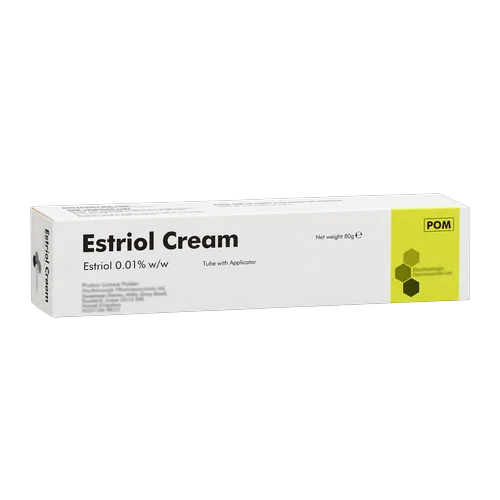
The product contains estriol 0.01% w/w and is supplied as a cream with an applicator.

Estriol is a naturally occurring oestrogen with relatively short receptor activity.

What it is used for

Vaginal estriol cream is used for symptoms caused by reduced oestrogen in the lower genitourinary tract, including vaginal dryness, burning, soreness and discomfort during intercourse.

Urinary symptoms can also respond when they are linked to genitourinary oestrogen deficiency, although new urinary pain, blood in the urine or fever requires separate assessment.

Ingredients

The cream contains estriol 0.01% w/w. Estriol is a naturally occurring oestrogen with relatively short receptor activity. The product is supplied in a tube with an applicator.

How it affects the body

Local oestrogen treatment acts mainly in tissues where it is applied. It can improve the condition of the vaginal lining, support moisture, increase tissue flexibility and help restore a more favourable local environment. NICE recognises vaginal oestrogen as an option for genitourinary symptoms associated with menopause, with treatment choice guided by symptoms, clinical history and patient preference [1].

Oestrogen receptors are present in vaginal, vulval and lower urinary tract tissues. When estriol activates these receptors, the tissue may become better hydrated, more elastic and less fragile. Improved epithelial function can also support the normal vaginal environment.

How to use it

  • Dose: The regimen for this strength should be confirmed with a healthcare professional before starting.
  • Route: Use the tube and applicator for intravaginal administration when prescribed; apply externally to vulval tissue only when specifically directed.
  • Frequency: The exact number of applications per day or week is not available for this product and must be confirmed with a healthcare professional before starting.
  • Timing: No specific time of day or relation to meals is established; this topical treatment is not taken orally.
  • Duration: The treatment duration and any change to a maintenance schedule must be confirmed with a healthcare professional before starting [2].
  • Application: Wash your hands before and after use, and do not cover the treated area with an occlusive dressing unless specifically directed.

Comparison

Topical Estriol formulations and delivery methods

Estriol can be administered locally in creams, gels or pessaries. These forms are not interchangeable because the concentration, applicator design, amount delivered and treatment schedule can differ.

Other local preparations illustrate why product-specific instructions matter:

  • Estriol intravaginal creams may be supplied in concentrations including 0.1% or 0.01%, depending on the prescribed product.
  • Creams can be useful when both internal and external symptoms need attention.
  • Pessaries provide a solid dose placed in the vagina.
  • Gels generally contain a smaller measured quantity and may feel less occlusive than a cream.

Creams may suit people who want a moisturising base and an applicator for internal use. Pessaries can be less messy for some users, while gels may be preferred when a lighter texture is important. The practical choice depends on symptoms, previous treatment, dexterity, vaginal discomfort and the clinician-confirmed regimen.

Comparison with alternative local oestrogen preparations

Estriol cream belongs to the local vaginal oestrogen group. Other local treatments use estradiol, another oestrogen with a different pharmacological profile and delivery system.

Local option Practical delivery Typical clinical role
Estriol 0.01% cream Cream applied with an applicator Local vaginal and vulval symptoms
Estradiol vaginal tablets Small tablet placed in the vagina Local vaginal symptoms with low-dose administration
Estradiol vaginal ring Flexible ring retained in the vagina Longer-interval local delivery

Clinical pathways may try more than one local oestrogen preparation when the first option causes discomfort, is difficult to use or does not provide enough relief. Prasterone pessaries are a specialised alternative in some formularies and may be reserved until topical lubricants and at least two topical oestrogen preparations have not provided adequate control. Local treatment should be selected by clinical suitability, not by concentration alone [3].

Systemic HRT alternatives and topical gels

Local estriol cream and systemic HRT serve different treatment goals. Estriol cream is directed at genitourinary symptoms. Systemic HRT is used when menopause symptoms require hormone exposure throughout the body, such as hot flushes, night sweats or widespread menopausal symptoms.

HRT patches can provide steady systemic estradiol exposure, but adhesive reactions may occur. An estradiol gel can be considered when a person develops skin irritation from patches, provided systemic HRT is clinically appropriate. Micronised progesterone may be needed alongside systemic oestrogen for someone with a uterus, because progestogen protects the endometrium from unopposed systemic oestrogen.

Do not use a systemic HRT gel on the vulva or inside the vagina. Its dose and absorption pattern are designed for skin application elsewhere on the body, not local vaginal treatment.

A common practical mistake is assuming that a local cream can replace systemic HRT for hot flushes. It generally cannot. Local estriol is intended for local symptoms and does not provide a full-body HRT regimen.

Common mistakes

Several practical errors can reduce benefit or cause unnecessary irritation:

  • Using a systemic oestrogen gel in place of vaginal estriol cream.
  • Applying extra cream after noticing leakage.
  • Using the cream only once, then expecting immediate relief.
  • Continuing treatment despite unexplained bleeding.
  • Forgetting that the applicator needs gentle handling when vaginal tissues are fragile.
  • Applying external cream internally without confirming the intended route.
  • Stopping as soon as dryness improves, then restarting repeatedly when symptoms return.
  • Using a lubricant, moisturiser or antifungal product at the same time without checking compatibility.
  • Assuming local estriol provides contraception or treats hot flushes.

Wash hands after applying the cream. Keep the applicator clean according to the product instructions and avoid sharing it. If insertion is painful, forcing the applicator can create small abrasions; a clinician may recommend an alternative formulation or a different application approach.

If the applicator causes discomfort, do not push through sharp pain. Pause, use gentle handling and report persistent insertion pain, bleeding or marked irritation to the prescribing service.

Who should not use it

Estriol is not suitable for everyone. This medication is not for you if you have any of the following unless a specialist has specifically directed treatment:

  • Current, previous or suspected breast cancer.
  • A known or suspected oestrogen-dependent cancer, including endometrial cancer.
  • Unexplained vaginal bleeding.
  • Untreated endometrial hyperplasia.
  • Current or previous venous thromboembolism, such as deep-vein thrombosis or pulmonary embolism, where oestrogen treatment is contraindicated.
  • Active or previous arterial thromboembolic disease, such as myocardial infarction or stroke, when relevant to the prescribing decision.
  • Severe liver disease or a history of liver disease while liver function remains abnormal.
  • Porphyria cutanea tarda.
  • Allergy to estriol or an excipient in the cream.

Medicines that increase hepatic enzyme activity, including some anticonvulsants and rifampicin, may alter exposure to sex hormones. St John’s wort can also affect hormone metabolism.

When this is not for you

Tell the prescriber about migraine with aura, epilepsy, gallbladder disease, lupus, diabetes, high blood pressure and a history of hormone-sensitive disease. Estriol cream does not provide contraception. Pregnancy is a reason to stop and obtain prompt medical advice, because vaginal oestrogen is not intended for routine use during pregnancy. Breastfeeding also requires a specific clinical decision.

Possible side effects

Local estriol is often tolerated well, but treatment can cause local symptoms during the first days or weeks. Possible effects include vaginal discomfort, itching, burning, irritation, increased discharge or spotting. Headache, breast tenderness or fluid retention can occur when some systemic absorption takes place.

Seek prompt medical assessment for unexpected vaginal bleeding, a new breast lump, persistent pelvic pain, leg swelling, sudden chest pain or unexplained breathlessness. These symptoms have several possible causes, and they should not be attributed automatically to local treatment.

HRT patches can cause adhesive skin irritation. A gel avoids the adhesive but can transfer to another person if the application area is touched before it dries. Local creams may feel soothing, yet some users experience leakage, messiness or irritation from the cream base or applicator.

The endometrium also requires attention. Low-dose vaginal oestrogen usually produces limited systemic exposure, but persistent bleeding needs assessment. If systemic absorption is clinically significant, endometrial protection with micronised progesterone may be relevant; this decision belongs to the prescribing clinician. The MHRA product information describes contraindications, warnings and monitoring considerations for estriol preparations [4].

A small amount of cream may leak after application. Wearing breathable underwear can make this easier to manage; inserting more product because of leakage can increase exposure without improving relief.

What doctors say

In clinical practice, doctors usually set expectations before treatment begins. Vaginal dryness may improve within weeks, while recurrent soreness, urinary discomfort and pain during intercourse can require longer treatment. Stopping after only a few applications may make a useful treatment appear ineffective.

A clinician will also distinguish menopausal genitourinary symptoms from infection, dermatological disease, pelvic floor dysfunction and unexplained bleeding. Ongoing symptoms can require examination rather than repeated increases in cream use.

Doctors also review the need for ongoing therapy. Some people need maintenance treatment because symptoms return when local oestrogen is stopped. Others may need a different formulation because of irritation, difficulty inserting the applicator or persistent symptoms.

Common questions

What happens when Estriol is stopped, and does it need tapering?

Symptoms can return after stopping because the underlying fall in local oestrogen remains. NICE guidance current in 2024 states that vaginal oestrogen may be continued for as long as symptoms require, with treatment reviewed according to individual circumstances. A taper is not always required for local estriol, but the prescriber may recommend reducing frequency to a maintenance schedule before stopping. Sudden bleeding or new pelvic symptoms after stopping require assessment rather than self-directed restarting. A clinician can tailor follow-up to symptom recurrence and treatment history.

How should Estriol cream be applied, and should the hands or treated area be covered?

The amount and frequency for Estriol 0.01% cream must be confirmed with a healthcare professional before starting. The supplied applicator is used for intravaginal administration when that route is prescribed, while external vulval application should follow the specific clinical instructions. Wash your hands after application, and avoid covering the area with an occlusive dressing unless specifically directed. MHRA product information available in 2025 describes the need for product-specific administration instructions because applicator doses differ between preparations.

Cosmetics and sunscreen should not be applied inside the vagina. External products used on the vulva can irritate sensitive tissue or interfere with the cream base, so leave a gap between applications unless the prescriber has advised combined use. NHS menopause guidance from 2024 supports non-hormonal moisturisers and lubricants as separate supportive options, but several vaginal products should not be layered without a clear plan. Stop an external cosmetic that causes burning, rash or swelling.

Does Estriol affect driving, concentration or work with machinery?

Vaginal estriol is not expected to impair driving or concentration for most users. The MHRA product information for estriol available in 2024 does not identify a routine psychomotor restriction for local estriol use. Dizziness, headache, visual disturbance or severe discomfort would make driving or machinery work unsuitable until the symptom has settled. Persistent or severe symptoms need clinical assessment rather than a change in the cream amount.

What should happen if the expected result does not come?

Relief may take several weeks, and pain during intercourse can persist when pelvic floor tension, infection or dermatological disease is also present. NICE guidance updated in 2024 supports review when symptoms do not improve, worsen or return quickly after treatment. Do not increase the amount independently, because a higher dose may increase irritation or systemic exposure. The clinician may assess the diagnosis, check application technique, review adherence or consider another local option such as an estradiol tablet or ring.

Can alcohol be consumed while using Estriol?

There is no routine alcohol prohibition specific to vaginal estriol in MHRA information available in 2025. Alcohol can worsen flushing, sleep disruption and bladder irritation, which may make menopausal symptoms feel stronger even when it does not directly block estriol’s local action. Avoid alcohol if it clearly aggravates burning, urinary urgency or night sweats. Alcohol does not make it appropriate to apply extra cream or alter the prescribed schedule.

Do you offer anonymous delivery?

Your order will be securely packed and shipped within 24 hours. This is exactly what your package will look like (images of an actual item sent). It has the size and look of a regular private letter (24x11x0.7 cm) and its contents cannot be seen.

Reviews: Estriol

Based on 4 reviews

Megan M., 31 Verified
Rating: 3 out of 5

I was younger than I expected for this problem and felt embarrassed at first. The dryness eased gradually, although the first applications caused mild stinging that settled.

Hull Several weeks 4 Oct 2026
Louise T., 41 Verified
Rating: 3.5 out of 5

After about a month, intercourse was less uncomfortable. The cream was slightly messy, and I found night-time use easier than applying it before work.

Dundee About a month 14 Oct 2026
Natalie S., 54 Verified
Rating: 3.5 out of 5

The burning and irritation improved, especially when I used the cream consistently. I still needed a separate lubricant, so it did not solve every symptom.

Cambridge Several weeks 20 Oct 2026
Emily, 60 Verified
Rating: 2 out of 5

I used it for several weeks but developed spotting and discomfort. I stopped and arranged an assessment rather than increasing the amount. A different local treatment was later discussed.

Norwich Several weeks 30 Oct 2026

Sources

  1. NICE (2024). Menopause: diagnosis and management, NICE guideline NG23.
  2. MHRA (2024). Estriol vaginal cream — Summary of Product Characteristics (SmPC).
  3. NHS South East London Integrated Medicines Optimisation Committee (2024). Local oestrogen preparations for genitourinary symptoms of menopause.
  4. MHRA (2024). Hormone replacement therapy (HRT) — official safety information.
Get our free app Shop faster and track your orders 3.5 · 225 reviews Install