Product information
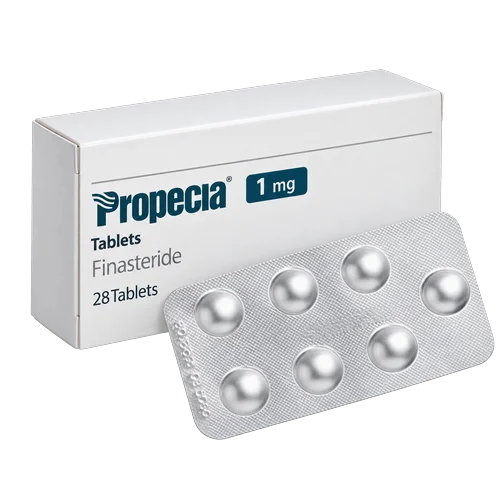
Propecia is a prescription oral treatment containing finasteride for adult men with androgenetic alopecia, also called male pattern hair loss or male pattern baldness. The condition develops when genetically sensitive hair follicles gradually shrink under the influence of dihydrotestosterone, or DHT.
The chosen strength and regimen should be confirmed with a healthcare professional before starting. Higher finasteride strengths have a different licensed use in prostate disease and should not be substituted for Propecia without a prescriber’s direction. Propecia is intended for men; women and children should not handle crushed or broken tablets.
Pattern of follicle miniaturisation
DHT affects susceptible follicles by shortening the active growth phase and progressively reducing the diameter of new hairs. Fine, short hairs may replace thicker terminal hairs over time. Finasteride targets this hormonal pathway, whereas cosmetic fibres and styling products only alter the appearance of existing hair.
What it is used for
Propecia is a prescription oral treatment containing finasteride 1 mg for adult men with androgenetic alopecia, also called male pattern hair loss or male pattern baldness. Male pattern baldness often begins with recession at the temples, thinning at the crown, or reduced density across the top of the scalp. Individual follicles respond differently, so treatment tends to preserve vulnerable hairs rather than restore every area of established baldness. Earlier treatment usually gives more remaining follicles to protect. The European Medicines Agency describes finasteride 1 mg as a treatment for androgenetic alopecia in men [1].
Take the tablet at a consistent time because a routine makes missed doses less likely. It does not need to be linked to breakfast or another meal.
How it affects the body
Finasteride inhibits type II 5-alpha reductase, the enzyme that converts testosterone into dihydrotestosterone. Lower DHT levels reduce the hormonal pressure that drives follicle miniaturisation in androgenetic alopecia. The treatment does not remove testosterone from the body and does not act as a general hormone blocker.
The biological sequence is straightforward:
- Testosterone is converted into DHT by 5-alpha reductase.
- Finasteride inhibits the type II form of this enzyme.
- Less DHT reaches susceptible scalp follicles.
- Follicles may remain in the growth phase for longer.
- Hair shedding can slow, and some miniaturised hairs may become thicker.
Finasteride works throughout the body, although the desired clinical effect is on scalp follicles. DHT also has roles in male reproductive tissues, which helps explain why sexual adverse effects can occur in some users. The FDA prescribing information describes finasteride’s inhibition of type II 5-alpha reductase and its effect on serum and scalp DHT [2].
A useful practical distinction is that finasteride addresses a hormonal driver of hair loss, while topical minoxidil supports follicle activity through a different pathway. Some clinicians use both approaches when the expected benefit outweighs the added treatment burden.
How to use it
Treatment is continuous rather than a short course. A reduction in shedding may appear before visible density improves, while noticeable changes commonly require three to six months of daily use. Assessment at 12 months gives a more reliable view of response because hair grows slowly and photographs taken under similar lighting are more useful than daily mirror checks.
- Swallow the tablet whole with water.
- Take one tablet daily, not extra tablets to compensate for thinning.
- Continue treatment only as prescribed.
- If a dose is missed, skip it and take the next scheduled dose.
- Do not take two tablets on the same day.
- Keep the dosing routine steady during travel, illness, or changes in working hours.
The finasteride regimen for the chosen strength should be confirmed with a healthcare professional before starting. The NHS and MHRA describe finasteride as a prescription treatment requiring appropriate clinical assessment before use [3].
Hair growth is slow enough that day-to-day inspection can be misleading. A monthly photograph taken from the same angle, distance, and lighting gives a clearer record than checking the hairline repeatedly.
Comparison
Propecia and generic finasteride 1 mg contain the same active substance and use the same pharmacological pathway when supplied in authorised equivalent formulations. The key issue is the active ingredient and strength, not changing between brand presentation and generic presentation without checking that the medicine remains finasteride 1 mg.
Finasteride 5 mg is intended for prostate-related indications such as benign prostatic hyperplasia. It is not the routine male pattern hair-loss strength. Dutasteride inhibits both type I and type II 5-alpha reductase and has a broader DHT-lowering effect, but its use for male pattern hair loss requires a separate clinical decision.
| Treatment category |
Main action and route |
Typical role |
| Finasteride 1 mg |
Oral type II 5-alpha-reductase inhibitor |
Male pattern hair loss in adult men |
| Minoxidil |
Topical or oral follicle-growth treatment, depending on formulation |
Hair-density support through a different pathway |
| Dutasteride |
Oral inhibitor of type I and type II 5-alpha reductase |
Selected cases requiring specialist assessment |
Topical finasteride is a separate preparation, not the same product as oral Propecia. Its formulation, absorption, authorisation, and clinical evidence can differ. It should not be assumed to provide identical exposure or identical safety characteristics.
Minoxidil can sometimes be combined with finasteride because the mechanisms differ. Combination treatment may increase practical complexity, and scalp irritation or unwanted facial hair can occur with topical minoxidil. Dutasteride may produce stronger DHT suppression, but stronger enzyme inhibition does not automatically mean it is the right first treatment.
Oral finasteride treats a hormonal contributor to male pattern hair loss. Minoxidil works through a different biological pathway and is applied to the scalp in topical formulations. A dermatologist may consider one treatment, the other, or both according to the pattern of thinning, medical history, tolerance, and treatment goals.
Finasteride is more convenient for men who prefer once-daily tablets, yet systemic exposure means sexual and psychiatric precautions matter. Minoxidil avoids the same systemic anti-androgen mechanism, but regular scalp application is essential and irritation can limit use. Dutasteride may be considered when response to finasteride is inadequate, although its broader enzyme inhibition calls for careful prescribing.
No treatment can guarantee restoration of a mature hairline. Propecia is more likely to preserve and thicken susceptible follicles than to recreate follicles that have been absent for many years.
Who should not use it
Propecia is not suitable for everyone. It is not for you if you are:
- A woman who is pregnant or may become pregnant.
- A child or adolescent.
- Allergic to finasteride or any tablet ingredient.
- Taking another finasteride-containing product without explicit prescribing instructions.
- Experiencing unexplained breast changes that have not been assessed.
Pregnant women must not handle crushed or broken Propecia tablets because finasteride can affect development of male external genitalia in a male fetus. Intact tablets have a protective coating, but handling should still follow the medicine’s safety instructions. Men should tell a healthcare professional if their partner is pregnant or may become pregnant.
Finasteride can lower serum prostate-specific antigen, or PSA, by approximately half after sustained use. A doctor interpreting a PSA result needs to know about finasteride because the measured value may otherwise appear lower than expected. This matters when investigating prostate symptoms or assessing prostate-cancer risk.
Tell the prescriber about:
- Liver disease or previous abnormal liver-function tests.
- Current or previous depression.
- Suicidal thoughts or other psychiatric illness.
- Fertility concerns or plans for semen testing.
- Breast symptoms.
- All prescription medicines, over-the-counter medicines, and supplements.
Finasteride is metabolised in the liver, although clinically important interactions are not common. The prescriber should still review medicines that affect liver function or hormonal pathways. Do not combine Propecia with another finasteride product to increase the dose.
Possible side effects
Clinical trials of finasteride 1 mg reported sexual adverse events slightly more often than placebo. Reduced libido, erectile dysfunction, and ejaculation problems were among the reported reactions. In the first-year trials described in the product information, sexual adverse events occurred in about 3.8% of men taking finasteride and 2.1% taking placebo; individual rates for reduced libido and erectile dysfunction were lower than 2% [4].
Possible adverse effects include:
- Reduced sexual desire.
- Difficulty achieving or maintaining an erection.
- Reduced ejaculate volume or ejaculation difficulties.
- Breast tenderness or enlargement.
- Testicular discomfort.
- Rash, itching, or swelling.
- Mood changes, depressed mood, anxiety, or suicidal thoughts.
Many sexual adverse effects resolved during treatment or after discontinuation in clinical studies, although post-marketing reports describe sexual dysfunction that persisted after stopping. The frequency of persistent symptoms cannot be estimated reliably from spontaneous reports. A new sexual symptom deserves a specific discussion with the prescriber rather than silent continuation or abrupt changes to the regimen.
Psychiatric symptoms require prompt attention. The MHRA has reminded patients and prescribers about depression, suicidal thoughts, and other psychiatric reactions associated with finasteride. Any suicidal thoughts require urgent help. New breast lumps, nipple discharge, persistent breast pain, or marked breast enlargement also need medical assessment.
A small but useful detail: reduced ejaculate volume can be noticeable without representing complete loss of fertility. Men being assessed for infertility should report finasteride use because semen parameters and sexual function may be relevant to the clinical picture.
If mood becomes persistently low after starting finasteride, do not wait for a routine hair review. Contact the prescriber promptly, and seek urgent help for thoughts of self-harm.
What doctors say
In clinical practice, doctors usually set a 6- to 12-month review point rather than promising a rapid cosmetic change. The first objective is often stabilising hair loss; visible thickening is a separate outcome and may be modest. A prescriber will also ask about sexual function, mood, fertility plans, liver history, and any breast symptoms.
A doctor may recommend baseline photographs, a scalp examination, or referral to dermatology when the pattern is unusual. Sudden patchy loss, scalp inflammation, scarring, or rapid shedding can suggest a diagnosis other than androgenetic alopecia. Finasteride should not delay assessment of those features.
The WHO pharmacovigilance framework treats suspected adverse reactions as clinically relevant even when a symptom is uncommon. Patients give clinicians better information when they report the symptom, its start date, its severity, and whether it changed after a dose adjustment or treatment interruption.