Skip to content
Fast & Discreet Delivery Save up to 80%
In Stock Clonidine
Cardiovascular Health

Clonidine

Clonidine hydrochloride, the active ingredient of Clonidine, belongs to a class of medicines called centrally acting alpha-2 adrenergic agonists. It is prescribed mainly for hypertension, though…

Guaranteed quality Original product
Delivery: from 4 days Discreet delivery
24/7 Support Always available
Active ingredient: Clonidine
Select pack Package Per tablet Price
£ 6.71 £ 67.08
£ 3.74 £ 134.16 £ 74.82 Save 44%
£ 2.78 £ 201.24 £ 83.42 Save 59%
£ 1.11 £ 603.72 £ 99.76 Save 83%
£ 0.90 £ 804.96 £ 108.36 Save 87%
£ 0.65 £ 1,207.44 £ 116.96 Save 90%
£ 0.49 £ 1,811.16 £ 133.30 Save 93%
Best value £ 0.44 £ 2,414.88 £ 158.24 Save 93%

Free delivery on orders from £ 172.00, free express delivery from £ 258.00

Secure payment methods:
VISA AMEX JCB DISCOVER

Clonidine hydrochloride, the active ingredient of Clonidine, belongs to a class of medicines called centrally acting alpha-2 adrenergic agonists. It is prescribed mainly for hypertension, though doctors also use it for menopausal hot flushes, ADHD, and withdrawal symptoms from opioids or alcohol. Clonidine works by stimulating alpha-2 receptors in the brainstem, which dampens the sympathetic nervous system's output.

Product information

Clonidine is a medicine containing clonidine hydrochloride as its active ingredient. It belongs to the class of centrally acting alpha-2 adrenergic agonists and is used mainly to treat hypertension.

What it is used for

It is prescribed mainly for hypertension, though doctors also use it for menopausal hot flushes, ADHD, and withdrawal symptoms from opioids or alcohol.

Where clonidine earns its place is in patients who also need help with hot flushes or withdrawal symptoms, where the central mechanism does double duty.

Ingredients

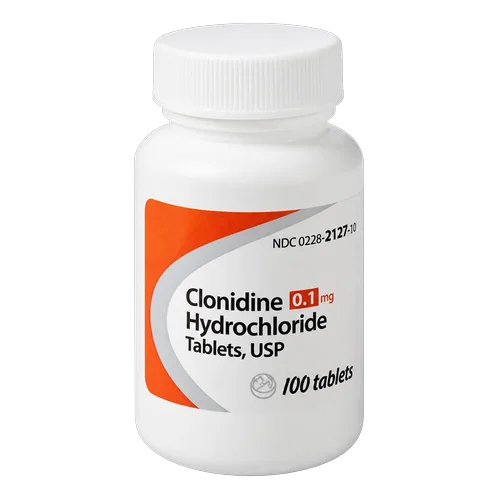
Clonidine hydrochloride, the active ingredient of Clonidine, belongs to a class of medicines called centrally acting alpha-2 adrenergic agonists. Dosing differs between strengths and between users, so there is no single amount that suits everyone. The product is supplied in bottles of 100 tablets.

How it affects the body

Clonidine works by stimulating alpha-2 receptors in the brainstem, which dampens the sympathetic nervous system's output. Less sympathetic drive means less norepinephrine release throughout the body, so blood vessels relax and heart rate slows. Blood pressure drops as a direct result of this reduced signalling, not because the heart or vessels are being acted on directly.

This sets clonidine apart from drugs like amlodipine (a calcium channel blocker that acts on vessel walls) or lisinopril (an ACE inhibitor that blocks a hormone pathway). Clonidine acts upstream, in the central nervous system, which is also why sedation and dry mouth are common. The MHRA's product information for clonidine notes this central mechanism as the basis for both its antihypertensive effect and its sedative side effects [1].

Clonidine's effect on sympathetic outflow is also why it helps with opioid and alcohol withdrawal — those withdrawal states involve a surge in sympathetic activity, which clonidine blunts.

How to use it

There is no single dose that fits every patient. Dosing differs between strengths and by individual response, and a doctor sets the starting dose and any increases based on blood pressure readings and tolerability. Start with the prescribed low dose. Increase it only under medical supervision. Keep dosing times consistent each day.

  • Tablets are taken orally, typically with water, with or without food.
  • Treatment usually starts low and is increased gradually over days to weeks.
  • Doses are often split across the day rather than taken once.
  • The tablets should be swallowed whole; they are not designed to be crushed or split for dose adjustment.
If you miss a dose, take it as soon as you remember unless it's almost time for the next one — in that case, skip the missed dose and continue as scheduled. Never take two doses together to compensate.

Missing doses matters more with clonidine than with many other blood pressure medicines. The body adapts to the reduced sympathetic tone, and an abrupt gap can let that suppressed system rebound sharply.

Comparison

Aspect Clonidine ACE inhibitors (e.g. lisinopril)
Mechanism Central alpha-2 agonist, reduces sympathetic outflow Blocks angiotensin-converting enzyme peripherally
Common side effects Drowsiness, dry mouth, rebound hypertension if stopped abruptly Dry cough, elevated potassium
Withdrawal risk High — must be tapered Low — can usually be stopped without tapering

Clonidine is rarely a first choice for routine hypertension in 2026 clinical practice. NICE and similarly structured European guidance favour ACE inhibitors, calcium channel blockers, or thiazide-like diuretics as initial therapy, reserving centrally acting agents like clonidine for cases that don't respond to those options or that have another indication running alongside hypertension [2].

Common mistakes

Patients frequently underestimate how gradual tapering needs to be when stopping clonidine, assuming that because the dose is small (0.1 mg), stopping abruptly carries little risk. It doesn't — the rebound effect is tied to the sympathetic nervous system's adaptation, not the raw dose size.

Another frequent error: taking clonidine at a different time each day because "roughly the same time" feels close enough. Blood pressure control with this drug responds better to consistent timing than many patients expect.

A third mistake is combining it with over-the-counter cold and flu remedies containing decongestants, which can counteract clonidine's blood-pressure-lowering effect without the patient realising why their readings have crept up.

Who should not use it

  • Severe bradycardia or significant heart block.
  • Breastfeeding, unless a doctor has specifically assessed the trade-offs.
  • Known hypersensitivity to clonidine hydrochloride or any tablet excipient.

Drug interactions to flag with your prescriber:

  • Beta-blockers — combined use raises the risk of rebound hypertension if clonidine is stopped first; the order of discontinuation matters.
  • Tricyclic antidepressants — can blunt clonidine's blood-pressure-lowering effect.
  • Other sedatives or CNS depressants — additive drowsiness, which affects driving and machinery safety.
  • Alcohol — intensifies the sedative effect beyond what either substance causes alone.

Severe depression, whether current or in the patient's history, is also something to discuss before starting, since clonidine has been linked to low mood in susceptible individuals.

When this is not for you

This medication may not be suitable if you have a very slow heartbeat or a heart block, are breastfeeding without medical advice, or have ever had an allergic reaction to clonidine or one of the tablet ingredients. Talk to your doctor before starting if you have severe depression or take beta-blockers, tricyclic antidepressants, sedatives, or alcohol.

Possible side effects

Drowsiness and dry mouth are the two side effects nearly every patient notices, especially in the first one to two weeks. Dizziness on standing up, constipation, and low mood are also reported.

  • Very common: dry mouth, drowsiness, fatigue
  • Common: dizziness, constipation, low blood pressure on standing, reduced libido
  • Less common but serious: significant bradycardia (slow heart rate), rebound hypertension after abrupt discontinuation

One thing patients often miss: the dry mouth doesn't fade the way drowsiness usually does over the following weeks. For some people it persists for the whole course of treatment, and sugar-free lozenges or frequent water sipping manage it better than waiting it out.

Taking the largest portion of a split daily dose at bedtime can shift most of the sedation into sleeping hours rather than the working day — ask your prescriber whether this timing suits your regimen.

What doctors say

In clinical practice, doctors tend to reserve clonidine for patients who've tried and not tolerated or responded to first-line antihypertensives. GPs often describe the sedation as the main limiting factor — some patients adapt within two weeks, others don't and switch therapy.

Prescribers watching for withdrawal issues usually build in a structured taper from day one of the conversation, not as an afterthought when stopping. "The patients who get into trouble with clonidine are almost never the ones taking too much — they're the ones who stopped without a plan," is a sentiment echoed across prescribing guidance rather than a specific quote, but it reflects how heavily tapering features in real-world management.

Common questions

Can I drive or operate machinery while taking Clonidine?

Caution is needed, especially in the first one to two weeks when drowsiness is most pronounced. The MHRA's guidance on centrally acting antihypertensives advises patients to assess their own alertness before driving and to avoid operating heavy machinery until they know how the medicine affects them. The MHRA product information available in 2024 also advises patients to assess their alertness before driving. Some patients adjust within two to three weeks; others experience ongoing sedation and should discuss alternatives with their prescriber if driving is a daily requirement.

How soon will I notice the blood-pressure-lowering effect?

Some blood pressure reduction can appear within thirty to sixty minutes of a single dose, but the fuller, stable effect usually builds over one to two weeks as the dose is titrated. The EMA's guidance on antihypertensive titration points out that gradual dose increases, rather than a single large starting dose, achieve steadier control with fewer side effects . Patients often judge the medicine too early, before titration is complete. The EMA guidance cited here was available in 2018 and supports gradual dose increases.

What should I do if I miss a dose?

Take the missed dose as soon as you remember it, unless the next scheduled dose is close, in which case skip the missed one entirely. Do not take a double dose to compensate. If more than one dose in a row is missed, contact your prescriber rather than resuming at the previous dose level, since blood pressure can rebound after even a short gap. NHS advice available in 2024 also recommends checking with a clinician after repeated missed doses.

Does Clonidine cause rebound hypertension if stopped suddenly?

Yes, this is one of the best-documented risks with this drug. Stopping abruptly, especially at higher doses, can cause blood pressure to rise above pre-treatment levels within hours to a few days, sometimes with a fast heart rate and headache. The WHO's essential medicines guidance specifically recommends tapering clonidine over at least several days rather than stopping outright . Anyone needing to stop should do so under medical guidance with a planned reduction schedule. The WHO guidance cited here was available in 2023 and supports supervised tapering.

How long does a single dose keep working?

A typical oral dose has effects lasting roughly six to eight hours, which is why clonidine is usually taken two or three times a day rather than once. Timing doses evenly through the day helps avoid the blood pressure swings that come from long gaps between doses. The MHRA product information available in 2024 describes divided dosing for some patients. A pharmacist can confirm whether the prescribed schedule matches the formulation.

Is Clonidine safe during pregnancy or breastfeeding?

Clonidine crosses the placenta and is present in breast milk, so its use in pregnancy or while breastfeeding needs individual assessment by a doctor weighing the mother's blood pressure control against potential effects on the infant. It is generally avoided during breastfeeding unless no suitable alternative exists. Anyone pregnant, planning pregnancy, or breastfeeding should raise this directly with their prescriber before starting or continuing treatment. NHS guidance available in 2024 also recommends an individual review of treatment during pregnancy and breastfeeding.

Do you offer anonymous delivery?

Your order will be securely packed and shipped within 24 hours. This is exactly what your package will look like (images of an actual item sent). It has the size and look of a regular private letter (24x11x0.7 cm) and its contents cannot be seen.

Comparison

All options for Cardiovascular Health at a glance

Reviews: Clonidine

Based on 3 reviews

Jack, 48 Verified
Rating: 4 out of 5

I was put on clonidine after two other blood pressure tablets didn't bring my numbers down enough. First ten days I was properly drowsy, could barely stay awake after lunch. That settled by week three. Dry mouth never fully went away, I just carry water everywhere now. Numbers are good though, consistently under 140 systolic for the first time in years.

Bournemouth First ten days; settled by week three 30 Oct 2026
Susan, 29 Verified
Rating: 3 out of 5

Started this for hot flushes rather than blood pressure, since mine runs on the low side anyway. Took about two weeks before I noticed fewer flushes. Downside was feeling a bit flat emotionally for the first month, which my GP said can happen. Still on it at a low dose and it's manageable.

Leeds First month 1 Oct 2026
Robert, 33 Verified
Rating: 2 out of 5

Honestly wasn't warned enough about stopping it properly. Ran out over a bank holiday weekend and couldn't get a repeat prescription for three days. My blood pressure spiked and I felt awful, racing heart, headache. Got it sorted once I could get tablets again, but now I keep a buffer supply so it never happens again.

Milton Keynes Three days without tablets 16 Oct 2026

Sources

  1. MHRA Summary of Product Characteristics (SmPC) — clonidine hydrochloride.
  2. EMA Guideline on clinical investigation of medicinal products in the treatment of hypertension.
Get our free app Shop faster and track your orders 3.5 · 225 reviews Install